As a new study confirms that the symptoms that follow antidepressant discontinuation are linked to withdrawal rather than relapse, its analysis suggests it’s time to update our tools for measuring them.
When symptoms emerge after an antidepressant is reduced or discontinued, one of the most important and difficult clinical questions is whether those symptoms represent withdrawal or a return of the underlying condition. Without a reliable way to differentiate these phenomena, clinicians may have difficulty determining what a patient’s symptoms actually represent, and how those symptoms should inform long-term treatment decisions. Yet distinguishing the two is often difficult because withdrawal can include many of the same affective symptoms that characterize depression and anxiety. One method has been to use the Discontinuation-Emergent Signs and Symptoms (DESS) checklist, introduced in 1998 by Rosenbaum et al.
A recent prospective longitudinal cohort study published in Psychotherapy and Psychosomatics examined the differentiation question by following 32 patients for 26 weeks during antidepressant tapering, with repeated assessments of affective symptoms, physical withdrawal symptoms, depression, and anxiety. Because measures such as the PHQ-9 and GAD-7 are for affective symptoms only and cannot distinguish withdrawal symptoms from relapse, the researchers also used the DESS to assess physical and affective withdrawal symptoms.
Affective symptoms rapidly increased following dose reductions and tended to decrease during periods when the dose remained stable. The authors suggest this corresponds to the arc of withdrawal symptomatology.
They found that affective symptoms rapidly increased following dose reductions and tended to decrease during periods when the dose remained stable, a pattern the authors considered consistent with the wave-like course of withdrawal. Physical withdrawal symptoms showed a modest association with changes in affective symptoms during tapering.
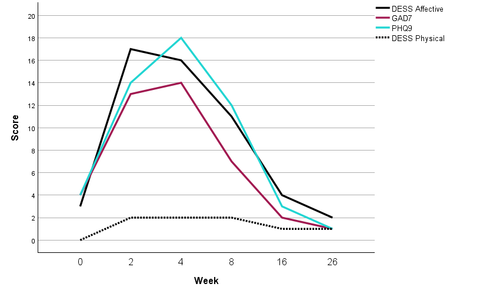
These charts present the data from two participants as examples. Participant A is a 20-year-old woman who had used escitalopram for 10 months, prescribed for compulsive behaviors. She went from 10mg to 5mg by week 2, paralleled by a large increase in DESS affective, GAD-7, and PHQ-9 scores, and a small increase in DESS physical subscale score. She then reinstated 10mg between weeks 2 and 4, which immediately slowed or even halted symptom increase. Thereafter, she made no further dose reductions and remained on 10mg until week 26, which was accompanied by full symptom resolution according to all four scales.
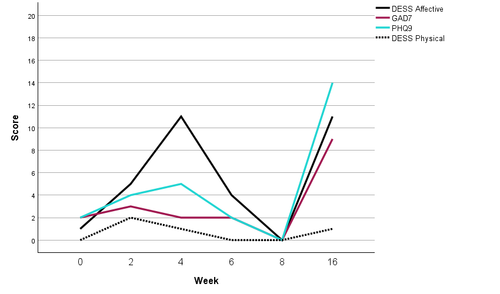
Participant B is a 40-year-old woman who was treated for 54 months with escitalopram. She started tapering from 20mg and reduced to 15mg by week 2. This was accompanied by a small but discernible increase in DESS affective, GAD-7, PHQ-9, and DESS physical subscale scores. She then further reduced to 10mg by week 4, which came along with a large increase in DESS affective subscale score. Between weeks 4 and 8, she remained on 10mg, during which period all symptoms fully resolved. By week 16, she made another reduction to 5mg, which induced a massive increase in DESS affective subscale score, GAD-7, and PHQ-9, as well as another small increase in DESS physical subscale score. Afterward, she felt so unwell that she withdrew from the study; her week 26 data are missing. (Image courtesy of Hengartner et al., 2026)
In a recent interview with Medical Xpress, one of the study’s co-authors, Dr. Mark Horowitz, said, “Our new research suggests symptoms may reflect withdrawal, and to avoid this, a slower tapering process is needed when stopping or reducing the dose….Clinicians should recognize that withdrawal is probably more likely than relapse while people are reducing antidepressants. An increase in symptoms should prompt a slower, more careful hyperbolic taper…rather than be taken as evidence that the medication must be continued long term.”
The study’s prospective design and repeated assessments provide valuable longitudinal evidence regarding the relationship between antidepressant tapering and emerging affective symptoms. Although the findings support that these symptoms may reflect withdrawal rather than relapse, further research is needed to clarify the extent to which these processes can be reliably differentiated. Continued refinement and validation of withdrawal assessment tools may help strengthen this distinction. For greater sensitivity, the 27-year-old DESS may need to be updated or replaced.